Getting your garage ready for a Tesla Wall Connector or Level 2 charger
A plug-in car charges fine from a regular outlet, just slowly. Here's what a proper Level 2 setup in your garage involves.
October 6, 2026 · 4 min read
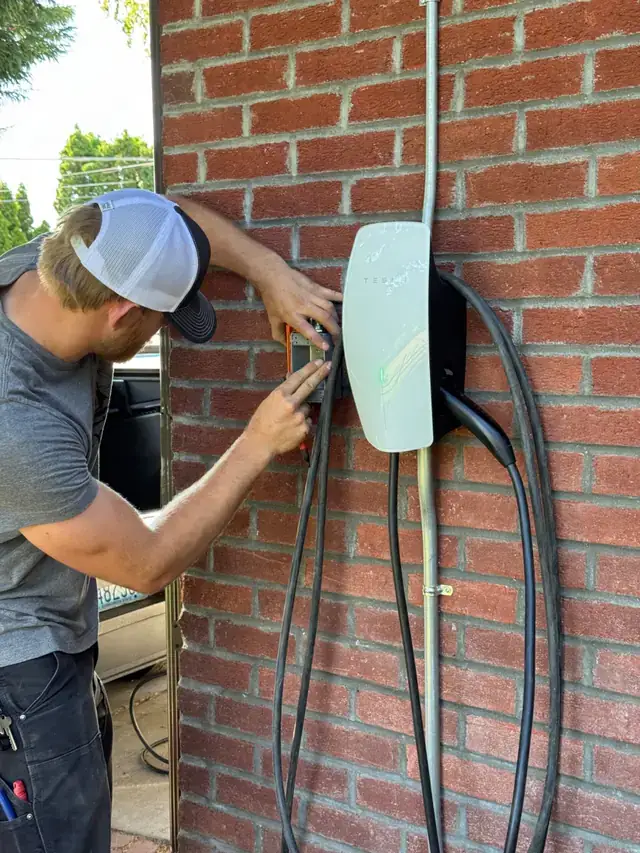
Owning an electric vehicle changes your relationship with the garage. It stops being a place where the car sleeps and becomes where it fuels up. A standard household outlet will technically charge a car, but it's slow enough that most owners want something better within the first few weeks.
That something is a Level 2 charger, and the Tesla Wall Connector is a popular choice. Wattsmart Electric has partnered with Tesla Motors and is a certified Wall Connector installer. We've installed many electric car chargers, so here's how the process goes.
It starts with a dedicated circuit
A car charger isn't like a lamp. It pulls a steady, heavy load for hours at a time. That's why it gets its own dedicated circuit, run directly from your panel to the spot where the charger will hang. Nothing else shares that circuit.
Running that circuit is most of the work. Depending on your house, the wire might travel through an attached garage wall in a few feet, or it might cross an unfinished basement, a crawlspace or an exterior wall to reach a detached shop. Distance and the way your house is built are what change the job from simple to involved. Ask us, and we'll tell you what yours looks like.
Does your panel have room?
This is the question that surprises people. A charger needs a good deal of capacity, and an older or already busy panel may not have it to spare. A full panel with no open breaker slots, or a service that's already running close to its limit, can mean an upgrade needs to come first.
If your panel is one of the older brands that electricians flag, a charger project is often the moment people decide to replace it. Wattsmart does panel upgrades in a single day, so the two projects can go together. Our article on Zinsco, Federal Pacific, Murray and Sylvania panels explains what to check.
Where to put the charger
- Near where you actually park. Cables are only so long, and you want the charging port to reach without stretching.
- Consider both ways you might park. If you sometimes back in and sometimes pull in, mount it where either works.
- Think about a second vehicle. If another EV is in your future, mention it so the layout and circuit planning make room for it.
- Keep it clear of the swing of the garage door, tools, bikes and storage.
- Think about weather. Some garages are open on one side, and a charger outside or on a covered porch has different needs than one tucked inside.
In practice, we've seen chargers mounted on drywall, on brick and on siding, inside garages and on exterior walls. Where yours goes depends on your house. A quick look is usually all it takes to find the best spot.
Wiring it right, then inspection
Once you get your free quote and have purchased your charger, our electricians run the dedicated circuit from your panel to your chosen location and mount and connect the charger. Then we schedule a virtual same-day inspection with an L&I Electrical Inspector, which keeps the whole installation moving. We've mainstreamed this process over many installs so that it's a smooth transaction.
One customer wrote that they had their Tesla charger installed in under a week, and that the whole thing was easy to work with. We can't promise your timing, because it depends on your panel and your schedule, but we work hard to keep it short.
Level 2 for businesses, too
If you run a shop, an office or a multi-unit property, charging can be a real draw for employees and customers. We install Level 2 commercial vehicle chargers and have worked on projects that include electric car chargers in larger residential developments. The same planning questions apply, with more of them: how many vehicles, how long they sit, and what your service can carry.
A few things to do before the first call
- Take a photo of your panel with the door open, and of the wall where you'd like the charger.
- Know which vehicle you drive and which charger you plan to buy, a Tesla Wall Connector or another brand.
- Think about whether you'll add a second car or an upgrade, such as a hot tub or workshop, in the next few years.
- Ask us about a rebate or incentive you may be eligible for. We don't quote programs in an article because they change.
Ready to plug in at home? See the details at /residential/car-chargers, check our work for businesses at /commercial, or call Wattsmart Electric at (509) 902-8040. You can also reach us through /contact.
Wattsmart Electric, (509) 902-8040
Call (509) 902-8040More articles
Zinsco, Federal Pacific, Murray and Sylvania panels: what's in your garage?
Four panel brands show up again and again when older Yakima Valley homes get inspected. Here's how to find out which one you have.
What a one-day panel replacement actually involves
Swapping a panel in a day sounds like a lot to fit into a Tuesday. Here's the sequence, and who handles which piece.